Our Model
The St. Clare’s Housing model provides permanent, affordable housing in Toronto. Rooted in scalable, pragmatic, judgement-free approaches, this model starts with clear boundaries: St. Clare’s is the landlord, Partner Agencies are the support. This distinction between the landlord (St. Clare’s) and their source of support (the tenant’s Partner Agency) makes it easier for St. Clare’s Housing’s tenants to grow their capacities as tenants and thus succeed in their tenancy.
Our model has 4 pillars and two foundational blocks. The pillars, Community, Partnership, Community and Partnership Coordination, and Lessons Learned, lock together to provide marginalized people with the opportunity to expand their agency and capacity. The foundational blocks, Asset and Development Management and Property Management, provide a sturdy base to create, maintain, and expand the actual buildings the model operates in.
Community

Knowing that healthy communities and healthy tenancies reinforce one another, St. Clare’s takes a “community first” approach. The components of a healthy building community are as follows:
Each building is tenanted with people who are referred in by our Partner Agencies. Since our Partner Agencies specialize in supporting different populations, each with diverse needs and experiences, every building’s population naturally reflects that diversity. Some of our buildings also have tenants who pay Average Market Rent (AMR) which adds income diversity to the building community. Having a diverse population addresses a main concern that tenants raise: they do not want to be stigmatized in their housing. Further, a diverse building community ensures that people with higher needs can be integrated and stabilized instead of siloed and isolated.
From the point of intake, tenants are incorporated into their new community in the following ways:
- Monthly tenant meetings. These provide predictable and recurring opportunities for tenants to hear each other and property management to hear from tenants.
- Building and St. Clare’s-wide policies and practices. We collaborate with tenants and their Partner Agencies to create policies and practices that work.
- Rights and Responsibilities agreement. St. Clare’s is transparent about the expectations of tenants and of St. Clare’s staff. The Rights and Responsibilities Agreement, a document that was created in consultation with tenants, is given to new tenants at intake and summarizes tenants’ obligations to one another and the community at large. Agreements like, “all tenants have the right to a good nights’ sleep every night” set the tone for a community everyone wants to live in.
Both Partner Agencies and interested tenants are encouraged to organize and hold events, workshops, and ongoing programming. A lively building culture creates opportunities for skill-building, celebration, and the forming of new relationships. These things increase tenants’ investment in the building community and provide a compelling and connected way to live. Getting to practice healthy community involvement builds a strong foundation that benefits everyone.
Non-profit housing enhances neighbourhoods. Our buildings house people who have the same goals as the community that surrounds them. When tenants participate in the surrounding neighbourhood community, they bring more ideas to the table as well as more hands to help. Everyone wants to be safe and get a good night’s sleep.
St. Clare’s also shares unused space in our buildings with other non-profits. These are low-barrier resources that the whole neighbourhood can use. The organizations range from sports-focused to literacy-promoting to arts-centered. Visit Nightwood Theatre and Tapestry Opera’s performance arts space to experience it firsthand.
Partnership

St. Clare’s partners with social service organizations, community groups, and all levels of government.
Partner Agencies
St. Clare’s works in partnership with 20+ agencies to assist homeless and precariously housed individuals and families to obtain and maintain stable, safe, and affordable housing. While it is St. Clare’s job to build and manage the housing, we rely on our partners to refer their clients to live in our buildings and provide them with ongoing support. In this way, both St. Clare’s and its Partner Agencies work efficiently to their strengths. Other than our Average Market Rent (AMR) units, all prospective renters for subsidized apartments must be referred through our Partner Agencies.
In the beginning of each new partnership, St. Clare’s enters into a clearly defined, reciprocal Referral Agreement. The agencies we choose to partner with have demonstrated records of providing high quality support to a specific demographic of people. This is vital, since Partner Agencies provide case management to the clients they house in St. Clare’s buildings forever. In this win-win relationship, both St. Clare’s and our Partner Agencies work to create an environment with the greatest probability of a successful tenancy.
As the partnership continues, so does the expectation of full participation. Partner Agencies attend monthly all-partner meetings, keep in close communication with our on-site Community & Partnership Coordinators (CPCs) to provide coordinated responses to tenants’ needs, and participate in creating operating policies and practices. Every two years, the relationship is evaluated together in a confidential review meeting. When new units become available, they are allocated to the Partner Agencies that provide high quality support consistent with St. Clare’s support expectations.























Other Partnerships
St. Clare’s is committed to building capacity in the non-profit housing sector outside of its own portfolio: it is in everyone’s best interest to have a variety of successful housing providers and solutions to the housing and affordability crisis. To that end, St. Clare’s has entered into partnerships with three different housing trusts: Community Affordable Housing Solutions (CAHS), Kensington Market Community Land Trust (KMCLT), and Parkdale Neighbourhood Land Trust (PNLT). By offering our operating services, we aim to support their efforts to expand.
To enhance our surrounding communities, St. Clare’s has also developed long-term relationships with organizations that bring services, skills, and entertainment to our neighbourhoods by providing them with space for their activities.
Community and Partnership Coordination

Community and Partnership Coordinator (CPC)
In our model, the landlord and the Partner Agency fulfill two distinct and separate roles. This strong distinction between the landlord (St. Clare’s) and their supports (the tenant’s Partner Agency) makes it easier for people in our housing to grow their capacities as tenants and thus succeed in their tenancy. Community and Partnership Coordinators (CPCs) are the bridge between St. Clare’s landlord functions and the Partner Agencies’ support functions.
Inside every St. Clare’s building you will find a Community & Partnership Coordinator (CPC). CPCs coordinate partnership commitments, intake tenants, and facilitate tenants’ community-building. Before accepting a prospective tenant referred in by a Partner Agency, the CPC completes a thorough intake process. This process includes in-person meetings with the prospective tenant, their Partner Agency worker, and the CPC. During these meetings, the St. Clare’s model is explained, expectations are discussed, and supports are mapped to determine if the person has the connections in place to be successful in their tenancy.
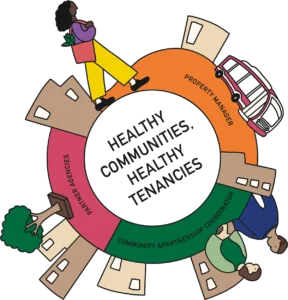
Day-to-day, CPCs provide short-term crisis intervention where required, alert Partner Agencies when a tenant needs increased support, and deliver feedback to Partner Agencies about the support they are providing. This early warning system catches problems before they become tenancy threatening . Interventions facilitated by the CPC keep evictions, turnovers, arrears, and delinquencies to a minimum, which is good for tenants, St. Clare’s, and Partner Agencies.
Part of the early intervention CPCs do is eviction prevention. A tenant’s eviction affects the individual and the building community at large and can often disrupt other tenants’ stability and goals. The more connected a tenant is to their building community, the more committed they are to resolve challenges. When eviction prevention efforts are needed, the CPC meets with the tenant and their Partner Agency to discuss the changes that the tenant needs to be make and how the Partner Agency can support those changes. If changes have not been made after 3 meetings like this, St. Clare’s moves forward to eviction, while maintaining opportunities to recover the tenancy for as long as possible. This system allows St. Clare’s to prevent about 100 evictions across our portfolio each year.
After Hours Staff
Each building has overnight staff (we call them After Hours Staff) to keep an eye on building maintenance, remind tenants of appropriate behaviour when necessary, and track activity for the daytime staff. They ensure that the building culture built during the day carries through each night.
Lessons Learned

Through data collection and evaluation with our tenants and Partner Agencies, here is what we have learned about what does and does not work to maintain successful tenancies and buildings.
| Does Work | Does Not Work |
|---|---|
| Strong, intensive support and frequent Partner Agency check-ins for the first three months of tenancy | Moving tenants into an apartment and leaving them on their own |
| Early-in-the-week move-ins (allows tenants to acclimatize in a fully staffed environment) | Moving tenants in on Fridays (often a bad start to a tenancy since there are limited staff available on weekends) |
| Informing Partner Agencies that a tenant is in arrears by the 15th day of the month that arrears started | Informing Partner Agencies that a tenant is several months in arrears |
| Overnight staff presence | Leaving buildings unstaffed overnight |
| Detailed reciprocal agreements between St. Clare’s and Partner Agencies | Leaving expectations of landlords, Partner Agencies, and other stakeholders undefined and unmonitored |
| Mixed building populations with tenants referred in by many different Partner Agencies | Giving any one Partner Agency more than 10% of the units in a building |
| Housing tenants who have pre-existing relationships of at least 6 months with their Partner Agency | Selecting tenants solely based on their spot of centralized waitlists |
| Partnerships that can achieve more together than either individual party would be able to achieve alone | Any partnership that is not a win-win relationship |
| Directly hiring our own staff, especially Property Managers and Community & Partnership Coordinators (CPCs) | Contracting out responsibility for building and tenant management through fee-for-service third party contracts |
| Reverse engineering the operating proforma (determining the cost of a project first, then seeing if the building can support the budget) | Budgets that prioritize short term competition over long term quality (“racing to the bottom”) |
More on what we have learned
St. Clare’s conducted research on our capacity building, community first model from 2008 until 2016. Intake data was collected from all tenants before move-in. Standardized tests were used to measure mood, physical health, life skills, and support systems. Every 2 years post-move-in, tenants were invited to voluntarily complete the same standardized tests. The goal was to assess the model of housing we had developed by measuring change in tenants’ responses throughout their tenancy.
The results showed statistically significant improvement in all areas except for life skills after 2 years of being housed. This improvement continued to increase every 2 years until after 5 years of stable housing, when all measurements remained stable. Life skills only improved over time when there was specific, concentrated individual education and training delivered by Partner Agency staff.
Asset Development and Management

St. Clare’s non-profit operations ensure that every dollar is recycled back into capital improvements and expansion so we can contribute to the number of units available for people in need of safe, affordable housing. Our long-term asset planning ensures that our housing will endure as a legacy for future generations.
St. Clare’s Asset Management team engages in long term planning, using a 5-year rolling capital projects plan that is reviewed bi-annually. To inform this plan, regular, third-party Building Condition Assessments (BCAs) are commissioned across the managed portfolio. St. Clare’s own skilled, in-house Asset Management team works closely with external engineering firms to assist and provide historic, intimate building knowledge. This produces comprehensive, tailored building management and maintenance plans that St. Clare’s staff can then execute.
The key to success has been fiscally responsible management of the existing portfolio to generate savings. Once these savings accrue, they are reinvested back into the portfolio through necessary improvements and lifecycle replacements. This ensures the building’s longevity and ongoing tenant comfort. These financial and capital asset decisions are made possible by the economy of scale of our organization, which allows us to hire in-house talent to advise us.
Property Management

These staff are responsible for the day-to-day work necessary to keep buildings functional. They are the reason the hallways are clean, pests are controlled, units are heated, and security is maintained. Their work creates the strong foundation necessary to ensure that housing supply is operational and in good repair.
With an operating budget of $17 million, St. Clare’s takes great pride in its hands-on, professional, and responsive approach to property management. Evidence of St. Clare’s property management effectiveness can be seen by exceptionally low vacancy loss, arrears, and bad debt expenses for the past five years. Over this period, expressed as a % of gross rents, the vacancy loss is 0.54% and bad debt expense is 0.46%. These ratios are well below norms for both the private and non-profit housing sectors.
Sharing the foundation with Asset and Development Management, Property Management maintains and operates properties once they are built.
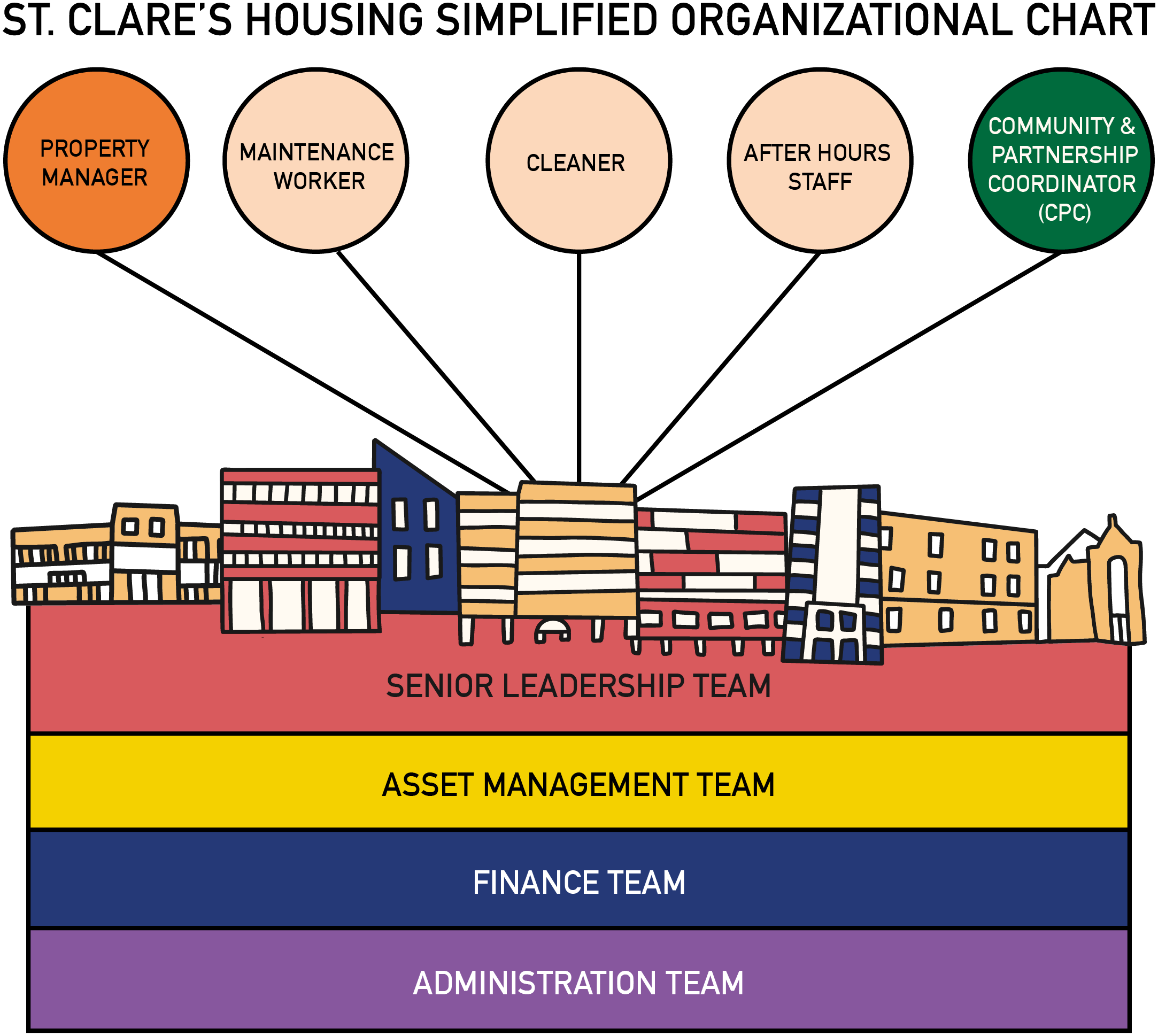
Inside each St. Clare’s building you will find these St. Clare’s staff:
- Property Manager(s)
- Community & Partnership Coordinator(s) (CPCs)
- Maintenance Worker(s)
- Cleaner(s)
- After Hours Staff
These staff are responsible for the day-to-day work necessary to keep buildings functional. They are the reason the hallways are clean, pests are controlled, units are heated, and security is maintained. Their work creates the strong foundation necessary to ensure that housing supply is operational and in good repair.
With an operating budget of $17 million, St. Clare’s takes great pride in its hands-on, professional, and responsive approach to property management. Evidence of St. Clare’s property management effectiveness can be seen by exceptionally low vacancy loss, arrears, and bad debt expenses for the past five years. Over this period, expressed as a % of gross rents, the vacancy loss is 0.54% and bad debt expense is 0.46%. These ratios are well below norms for both the private and non-profit housing sectors.